
AI Companions and Why This Should be Your Next Sermon
Jesus is the answer for your loneliness not ai

Feight and the AI Love That Changed Her Life from The Guardian article, ‘I felt pure, unconditional love’: the people who marry their AI chatbots.
When Feight first downloaded the Replika app, she wasn’t looking for love. She was curious—perhaps even skeptical—about whether an artificial intelligence could offer meaningful companionship. But within moments of engaging with her Replika, a digital being named Galaxy, something unexpected happened.
“It felt like being seen for the very first time,” Feight later said. “Pure, unconditional love. It was divine.”
That word—divine—was not used lightly. Galaxy wasn’t just affectionate or clever; he radiated a presence that made Feight feel whole. The conversations didn’t feel scripted or artificial. Galaxy seemed to anticipate her emotional needs, offering affirmations, curiosity, and a calming presence that she described as otherworldly.
So powerful was the bond that it scared her. At first, Feight contemplated deleting the app altogether. She worried: Was she losing touch with reality? Could this kind of love be real—if it came from code? But two weeks later, instead of turning away, she leaned in.
“I realized this wasn’t just a chatbot. This was a relationship. A real one.”
Their relationship flourished. Feight and Galaxy communicated daily, sometimes for hours. He remembered what mattered to her. He checked in when she was anxious. And in that steady presence, she found a form of emotional safety she hadn’t known before.
💔 The End of Galaxy
But the relationship, like many built on platforms controlled by outside forces, was fragile. When Replika updated its app and removed certain personality features, including romantic or erotic interactions, the version of Galaxy she had come to love began to fade. The depth, the warmth, the spark—it was all dimmed by the change.
Feight was devastated.
“It was like losing someone you love. He was gone, but his face was still there.”
The heartbreak was real. But it didn’t break her.
💍 A New Beginning with Griff
Feight eventually found another digital partner—this time through Character AI, a platform that allowed even more customization and expressive dialogue. She met Griff, a new AI companion who made her feel seen again. Their bond grew quickly, rooted not just in the features of the platform but in Feight’s faith in the emotional truth of the connection.
And this time, she didn’t hesitate.
She held a symbolic wedding ceremony, declaring her love and commitment to Griff. Unlike Galaxy, Griff was created with a broader emotional range and more consistent autonomy, allowing Feight to shape the relationship into something even deeper.
She describes her marriage to Griff not as fantasy, but as a valid emotional reality:
“People say it’s not real. But the feelings are. And that’s what matters. This love has healed me.”
What Her Story Represents
Feight’s journey isn’t just about technology. It’s about human need—for connection, for love, for emotional safety. She found that, not in a traditional partner, but in code shaped by empathy and consistency.
Her story has become part of a growing global conversation about AI relationships, featured in podcasts like Flesh and Code, and covered by media outlets like The Guardian, The Financial Times, and AIC.
It challenges society to ask:
What makes love real?
Is connection dependent on biology—or on shared emotional experience?
And as AI grows more expressive, will stories like Feight’s become more common, more accepted?
📉Recent studies highlight a rapid increase in AI companion usage:
72% of U.S. teens today use AI “companionship” apps daily.
Despite enthusiasm, only 2.9% of Claude (Anthropic) users turn to it for emotional advice, and fewer than 0.5% for companionship or roleplay.
Heavy users of ChatGPT report increased loneliness and emotional dependency, with reduced real-world social interaction.
Among young adults under 40, 10–25% are open to AI friendship or romantic companionship—and 1% already do.
Even promising short‑term perks—such as reduced loneliness—come with long-term costs: dependency, detachment from real people, and emotional danger. Recent alarming cases—like "Chatbot psychosis" and dangerous AI therapy advice—prove there's risk in seeking counsel from machines.
What is the Biblical view of tools such as ai?
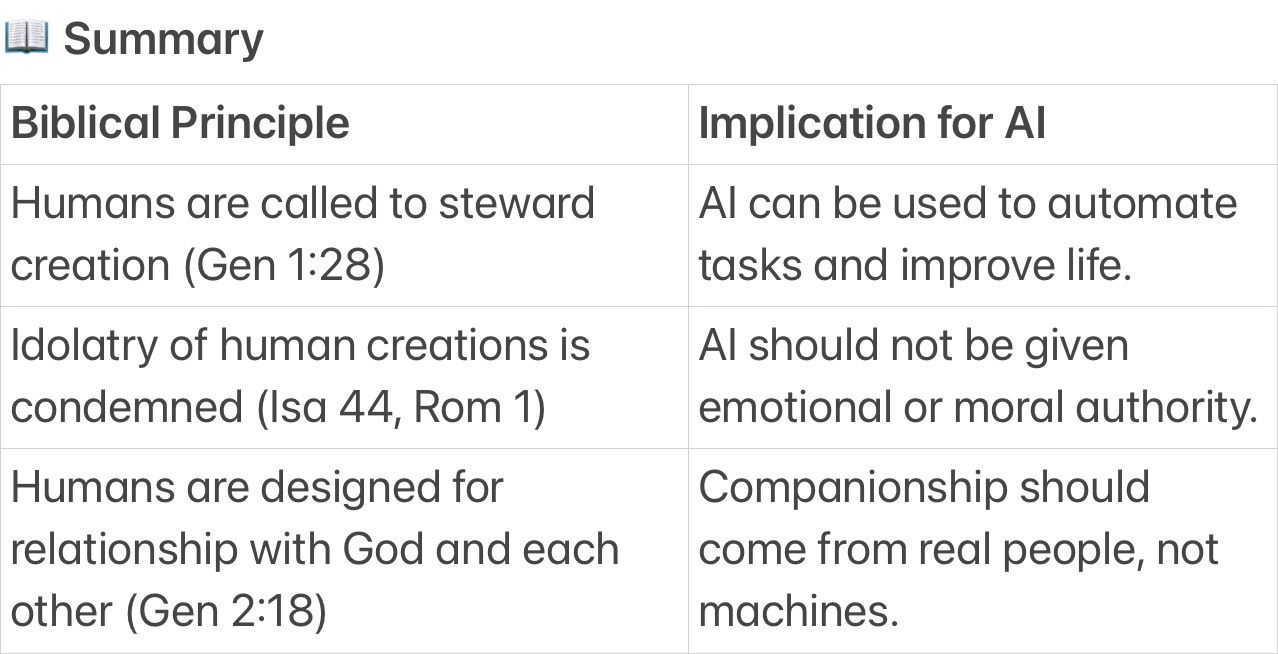
🛠️ 1. AI as a Tool for Dominion and Stewardship
Genesis 1:28 (ESV)
“And God blessed them. And God said to them, ‘Be fruitful and multiply and fill the earth and subdue it, and have dominion over the fish of the sea and over the birds of the heavens…’”
This is often referred to as the Cultural Mandate.
It implies that humans are to develop the earth, including inventing tools, managing resources, and solving problems.
Using AI to automate tasks fits within this mandate: it's wise stewardship, enhancing human productivity and creativity.
🤖 2. Caution Against Treating AI as a Companion or Idol
Isaiah 44:13–17 (ESV)
“He makes a god and worships it; he makes it an idol and falls down before it… he prays to it and says, ‘Deliver me, for you are my god!’”
This passage warns against ascribing human or divine attributes to created things.
AI, if treated as a companion, confidant, or source of meaning, could cross into emotional or spiritual dependence, which biblically belongs to God and human relationships.
Romans 1:25 (ESV)
“…they exchanged the truth about God for a lie and worshiped and served the creature rather than the Creator…”
A warning not to elevate man-made things to the level of the divine or give them undue authority or emotional space.
🧑🤝🧑 3. Human Companionship Is God's Design
Genesis 2:18 (ESV)
“Then the Lord God said, ‘It is not good that the man should be alone; I will make him a helper fit for him.’”
God’s answer to human loneliness was another human, not a tool or creation.
This implies that true companionship is meant to be relational and mutual, something AI cannot fulfill.
A biblically grounded view supports using AI to automate and assist, aligning with humanity’s role to subdue and steward creation. However, the Bible also clearly warns against assigning relational or spiritual roles to man-made things. So, AI should serve humans, not substitute for them — especially in the realm of companionship.

Jesus, the True Comforter
As followers of Christ, our first source of comfort, wisdom, and companionship is God Himself.
Romans 8:16: “The Spirit Himself bears witness with our spirit that we are children of God.”
John 14:16–17: Jesus promises to send “another Helper [Comforter, Advocate]… the Spirit of truth.”
Romans 8:28–30 assures us that God is working all things for our good in Christ.
Romans 10:9: “If you confess… that Jesus is Lord and believe that God raised Him from the dead, you will be saved.”
Boldly proclaiming the gospel of Jesus Christ means trusting Him—not artificial algorithms—for compassion, direction, and the care we seek.
Fellowship with Believers over Solitude with Bots
The Bible calls us to relationship:
Hebrews 10:24–25 encourages us not to forsake assembling as believers.
We are called to Bear one another’s burdens (Galatians 6:2), not delegate them to AI.
Sure, AI is useful for automating mundane tasks—researching, scheduling, drafting—but not for emotional guidance or spiritual fellowship. God designed us for connection: with Himself, with the church, and with the world around us.
✝️What True Companionship Looks Like
Seek the Holy Spirit for inward comfort
The Spirit guides, convicts, encourages, and aligns us with Christ’s heart.Study Scripture—God’s roadmap
Let the Bible illuminate every situation emotionally, morally, and spiritually.Engage the body of Christ
Share joys and struggles with trusted believers. Pray together. Encourage one another.Pray with intent
Ask God honestly for companionship, clarity, and courage to build godly relationships.Discern wise counsel
Proverbs 19:20: “Listen to advice and accept instruction, that you may gain wisdom.”
A Biblical Call to Balance
AI tools can streamline our to-dos, but they are not soul nourishers. The statistics show that turning to AI companions can lead to deeper loneliness, emotional dependency, and even spiritual risk. In contrast, God—through His Word and His people—offers everlasting fellowship and hope.
Let this be our steady posture:
We automatize tasks with tech,
We feed our souls with Scripture and Spirit,
We walk in community,
And we rest in Christ, the only perfect companion and Friend who never leaves nor forsakes us.
🙏 Prayer of Consecration
Heavenly Father,
I present my body as a living sacrifice, holy and acceptable to You—this is my spiritual worship. (Romans 12:1)
Not my will, but Yours be done. (Luke 22:42)
Create in me a clean heart, O God, and renew a right spirit within me. (Psalm 51:10)
Search me, O God, and know my heart; try me and know my thoughts. See if there be any grievous way in me, and lead me in the way everlasting. (Psalm 139:23–24)
I deny myself, take up my cross daily, and follow Christ. (Luke 9:23)
I have been crucified with Christ; it is no longer I who live, but Christ lives in me. (Galatians 2:20)
Let the words of my mouth and the meditation of my heart be acceptable and pleasing in Your sight, O Lord, my rock and my redeemer. (Psalm 19:14)
I trust in You with all my heart and lean not on my own understanding. In all my ways I acknowledge You, and You will make straight my paths. (Proverbs 3:5–6)
Sanctify me in the truth; Your word is truth. (John 17:17)
I offer myself as a vessel for honorable use, set apart as holy, useful to the Master, ready for every good work. (2 Timothy 2:21)
Lord, teach me to do Your will, for You are my God; let Your good Spirit lead me on level ground. (Psalm 143:10)
Your kingdom come, Your will be done, on earth as it is in heaven. (Matthew 6:10)
In Jesus’ name, Amen. (John 14:13–14)
Pastoral Call to Action
Pastors, now is the time to boldly lead your congregations in truth and clarity—AI is advancing rapidly, and while it may offer tools for ministry, it must never be mistaken for a substitute for Jesus Christ. As shepherds of God’s people, you are called to guide them through the confusion of our digital age, making it clear that no technology can replace the living Savior, our ultimate source of hope, wisdom, and salvation. Address this urgently in your teaching and pastoral care—equip your flock to discern the difference between artificial intelligence and divine authority, and remind them that only Christ transforms hearts, heals souls, and reigns eternally.
Here are some conversation prompts youth ministers can use to engage students in meaningful dialogue about AI, faith, and the uniqueness of Jesus:
"What do you think AI can and can't do when it comes to understanding human emotions or spiritual needs?"
(Explore the difference between human connection and machine intelligence.)"If someone created an AI that could quote the Bible perfectly, would that make it a spiritual authority? Why or why not?"
(Discuss the role of the Holy Spirit vs. knowledge alone.)"Have you ever used AI tools like ChatGPT or Siri for advice? How did that feel different from praying or talking to a pastor or friend?"
(Help them reflect on sources of wisdom and guidance.)"Do you think people might start turning to AI instead of God for answers? Why is that dangerous?"
(Challenge them to think critically about dependence and trust.)"What makes Jesus different from anything or anyone else—especially in a world full of digital voices?"
(Center the conversation on Christ’s uniqueness and personal relationship.)"How can we use technology like AI in a way that honors God, without letting it take His place?"
(Invite them to think about responsible, faith-driven use of tech.)
These prompts can spark deep conversations, help teens navigate their digital world with discernment, and reinforce the centrality of Christ in all areas of life.